
Black-and-white tiles
She had been born in a coastal city in Andalusia.
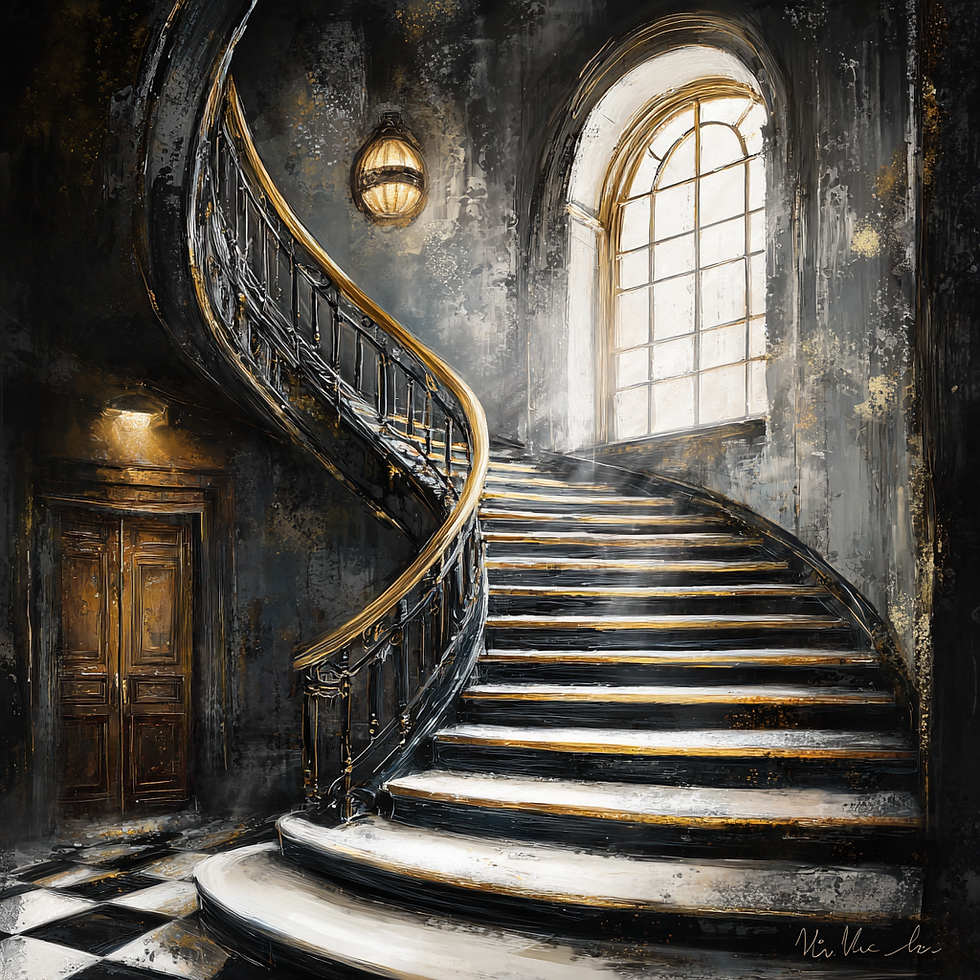
The entrance to her house began with a solemn door that spilled onto the last step of a winding staircase sprinkled with small tiles alternating black and white, like an analogy of what her childhood would become. That geometry, present beneath her feet, would end up as a metaphor throughout her entire life.
Orphaned of her father at an early age, she became the shoulder to cry on for a young widow raised for little more than being a good woman to some good man.
The roulette of life landed on black, and at only eight years old she learned the meaning of responsibility and the firmness needed to carry things forward.
Her home reflected part of a society that had once enjoyed a better past: a large house with high ceilings, walls crowded with dark Baroque paintings, and large wardrobes crowned by suitcases that had crossed many borders.
That house opened into a grand living room whose center was occupied by a gleaming golden brazier, like the aimless compass of a ship without sails. That ancient dimness contrasted with the energy of the cook, who beheaded chickens with the ease of a well-learned trade, and with the sharp scent of the painting room that opened onto a sea of rooftops topped by the cathedral of Málaga.
Amid those contrasts she understood that, for every setback, there was always an alternative, a new white tile. And with the determination of youth, she resolved to paint her own strokes and trust her intuition. From then on, everything became a discovery. She learned that her family was larger than she had imagined and, hand in hand with her new cousins and uncles, she opened herself to a different universe of harmonious relationships. That circle widened as she began working at City Hall and discovered her ease for connecting, for smiling, and she felt, at last, that the moment had come to enjoy her turn on the white tiles.
Of the many suitors she had, she chose the general’s son. Surely because he came from a family that offered the rooted sense of belonging she had always longed for, but above all because they were both stray verses in their own families and shared the desire to leap toward a happier horizon than the one in which they had grown up.
She adored the tenderness of children, so she had seven and poured into them all the attention needed to build a safe place, along with the endless energy demanded by so many little ones with so many constant needs. For a long time, life gifted her only white tiles, until she began to sense the thick fog that announced a change of season. A change in the alternation. And so, without pause and with an almost imperceptible rhythm, she slowly entered an unknown and increasingly blurred world, where the borders of the familiar dissolved and everything she loved evaporated before her eyes—eyes now unable to retain a single memory, neither good nor bad.
The long shadow of her illness stitched wounds into the souls of all her loved ones, who grew smaller as she drifted away. And today, the memory of what we once were lives on in the magic of celluloid, which her husband captured with such tenderness, almost sensing that it would be the only plank left afloat after the shipwreck of our captain.
CFC



Comments